
Authors: Natalia Jasztal, Madelief Alserda
Investigators: Cyber War Crime Task Force, D.D., Joshua Ram, Vyacheslav Kolomeets
Editor: Janthe Van Schaik
On December 12, 2023, Kyivstar, the largest Ukrainian telecommunications company with approximately 24 million users nationwide, experienced a cyberattack that resulted in widespread disruption of mobile and internet communications. The cyberattack targeted Kyivstar's IT infrastructure, causing widespread service outages and affecting systems that support air raid alerts in parts of Kyiv. Its purpose was most likely to degrade civilian morale, disseminate propaganda, and provide strategic advantages for military operations - all in line with the Russian Federation's strategic approach of conducting parallel kinetic and cyber operations.
Russia’s military doctrine updated in 2014 provides potential evidence of the synthesis of military and nonmilitary methods of warfare by the Russian Federation. It explicitly emphasizes using political, legal, economic, and informational instruments alongside military force and calls developing of dedicated information warfare capabilities. The doctrine also recognizes the growing shift of conflict/battles into the information space, reflecting an understanding of warfare that extends beyond traditional kinetic operations [1]. Since the publication of the doctrine, several Russian government officials and publications have emphasized the role of cyberwarfare for their military/security apparatus [2]. The current Russian information/cyber warfare apparatus is presented holistically by the International Institute for Strategic Studies.
Statement by Russian hacktivist Solntsepyok on Telegram
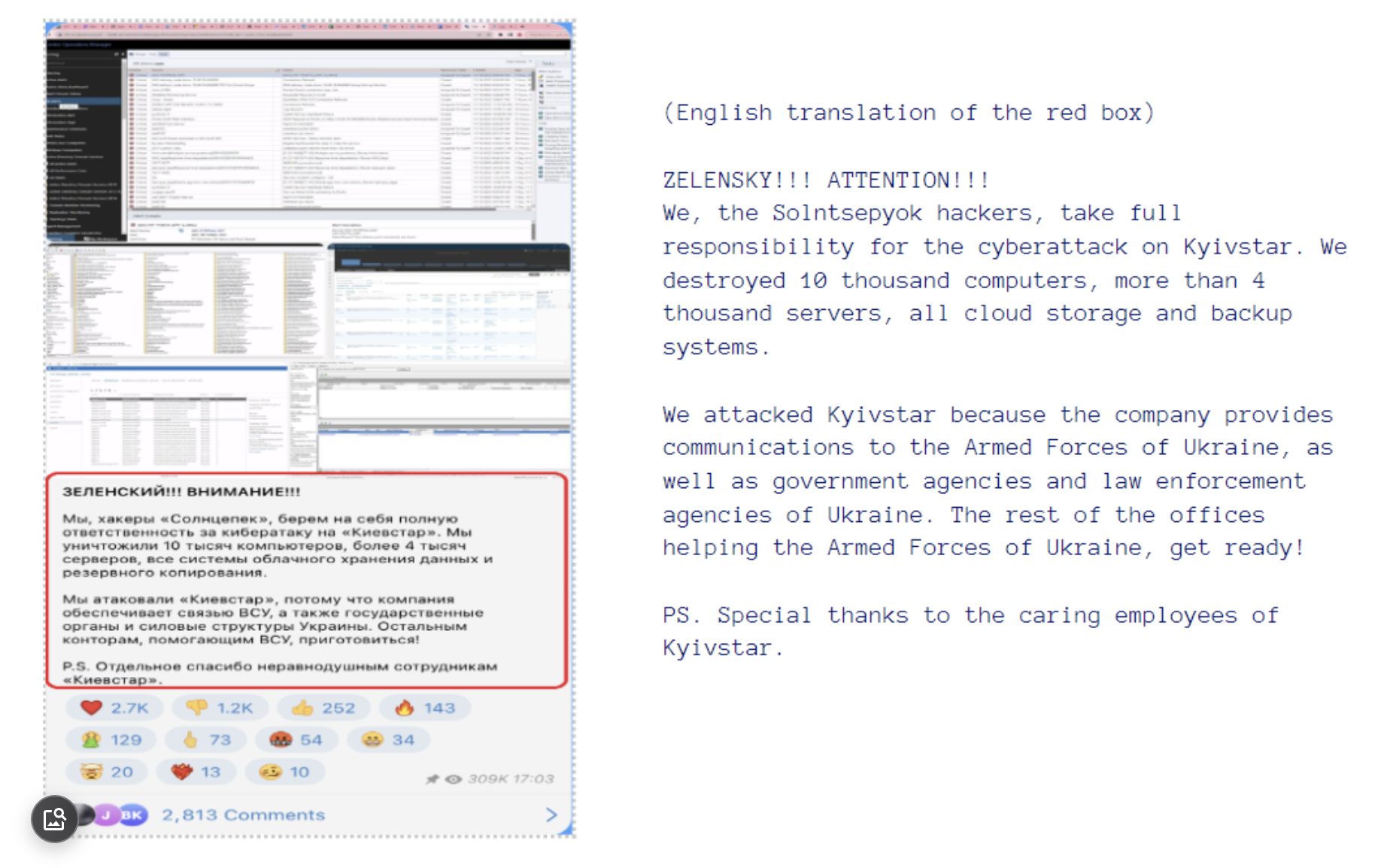
Various pro-Russian hacker groups claimed responsibility for the attack, including Solntsepek (Солнцепек), which on December 13, 2023, issued the following statement: “We, the Solntsepek hackers, take full responsibility for the cyber-attack on Kyivstar. We destroyed 10 thousand computers, more than 4 thousand servers, and all cloud storage and backup systems. We attacked Kyivstar because the company provides communications to the Armed Forces of Ukraine". The head of the SBU (Ukraine’s Security Service), Illia Vitiuk, affirmed that he suspects that Solntsepek is affiliated with the Main Directorate of the General Staff of the Russian Armed Forces (GRU) and the Russian-backed military cyber unit Sandworm. The hacker group Sandworm has been linked to other cyberattacks in Ukraine, posing a significant vulnerability to the digital resilience of Ukraine’s military and civilian population [3].
Given Kyivstar's critical role in serving both military and government entities, the 12th of December attack appears to be part of a broader strategy targeting key telecom infrastructures.
As Europol has observed, “the threat landscape has also evolved; attribution is complex in cyber contexts, cybercrime is growing in scope, number of attacks, financial impact and sophistication, jurisdiction is problematic, and the range of offenders and threat actors continues to grow” [4]
Its transnational nature makes it extremely difficult not only to investigate, but also to exercise jurisdiction and accountability under existing legal frameworks.
Current cyberattacks are becoming increasingly complex, and the Kyivstar attack serves as a clear example of how difficult it is to attribute responsibility both in personal and geographical terms. The following paper examines this attack in greater detail and explores the relevant national and international legal frameworks, as well as the associated challenges and potential avenues for accountability.
Legal background: The role of cyberoffenses in IHL
The International Committee of the Red Cross (ICRC) has expressed its concerns about the new role that cyberwarfare plays in modern conflicts, but has reaffirmed that IHL applies the same to cyberwarfare as it does to other forms of kinetic warfare.
“For the ICRC, there is no question that IHL applies to, and therefore limits, cyber operations during armed conflict - just as it regulates the use of any other weapon, means and methods of warfare in an armed conflict.“ [5]
Under Art.36 of the 1997 Additional Protocol I, all contracting parties have the obligation to determine whether the employment of new weapons or methods of warfare is prohibited by the Protocol itself or other international laws applicable to the contracting party. This article, hence, reaffirms that contracting parties are held to identical obligations under IHL regardless of whether this method of warfare was present at the time of the Protocol’s drafting. For purposes of legal accountability, the obligations for contracting parties for the deployment of cyber capabilities are identical to those for traditional means of kinetic warfare and are, thus, held to the same legal standard. [6]
The applicability of IHL in the specific context of cyber as a military domain has been further explored in the Tallinn Manual created by the NATO Cooperative Cyber Defence Centre of Excellence. While the Tallinn Manual provides a non-binding study on how cyber and cyber operations can be understood under international law, it still offers expert opinions based on consensus from scholars and legal experts globally [7]. Under Rule 80 of the manual, the International Group of Experts unanimously determined that even though cyber operations are novel methods of warfare, they are subject to the same laws of armed conflict as any other domain of war [8].
The ongoing armed conflict between Russia and Ukraine is marked by both kinetic and cyber means of warfare and requires comprehensive legal accountability for violations of IHL in all domains of warfare. To determine possible means of legal accountability, both domestic and international legal frameworks are of importance, which are further evaluated in the following legal analysis.
Legal Analysis
IHL and customary law aim to protect individuals in armed conflict, especially civilian populations that are particularly vulnerable in times of armed conflict. As previously discussed, the ICRC affirms that the laws of armed conflict are applied the same to cyber operations as with any other domain of warfare, such as air, land, and sea. Therefore, principles of distinction also apply to cyber operations, which obligate states to make a distinction between civilian and military objectives. [9]
The Kyivstar attack targeted Ukraine's main mobile network, Kyivstar, which provides phone and internet access to citizens of Ukraine. The deliberate targeting of civilian infrastructure resulted in 24 million users not having access to vital means of communicating with those in and outside of Ukraine [10]. This attack presented two key indicators of violating Art. 13 of Additional Protocol II of the Geneva Conventions relating to the Protection of Victims of Non-International Armed Conflicts.
Firstly, the deliberate targeting of critical communications infrastructure removed the possibility for Ukrainians who use the Kyivstar networks to communicate with loved ones and communicated the vulnerability they are currently exposed to, with the aim of spreading terror to those affected. Attacks that are aimed at spreading terror are equally seen as strategies that violate the principle of protecting civilian populations [11].
Secondly, the intentional acts of crippling the Kyivstar network are also understood to have been aimed at halting the functioning of air-raid sirens that are vital in protecting civilian populations from missile and drone attacks [12].
Furthermore, the targeting of these specific communications networks has also been claimed by the Solntsepek group to disrupt communication resources of the Ukrainian armed forces and other government agencies. By targeting civilian infrastructure, the cyberattack resulted in critical infrastructure aimed at protecting civilian populations not functioning in certain regions, thus putting civilians at considerable risk of drone and/or missile attacks. This targeting violates both principles of precaution and distinction and results in the civilian populations being put under unnecessary duress and harm. Firstly, the cyber attack has made no effort to make a distinction between possible military uses of this network and civilian uses, and it could be argued that it has been perpetrated solely to target civilian targets to spread fear, as mentioned prior. Secondly, this attack provides little consideration for precautions to minimize the effects of military operations that could affect protected persons, such as civilians [13]. By harming the functionality of the Kyivstar network, the functioning of air-raid sirens was halted in some regions, and no precaution was taken to avoid the destruction of this critical infrastructure.
Additionally, Russian forces launched an air attack on Kyiv on multiple instances from the 8th of December to the 13th, which led to civilians being harmed by debris from the shot-down missiles. The targeting of the Kyivstar network was primarily due to its functionality for military and government communication.
Even though the network served some military purposes, the attack failed to comply with the principles of precaution and distinction, as the network’s fundamental role still served as civilian infrastructure.
Individual responsibility
The challenge with cyber operations is that identifying the criminal responsibility of those who violated national or international law is uniquely complicated due to the digital and often anonymous nature of cyberspace. Another dimension that complicates the legal process is a lack of certainty about the location where the perpetrator has committed the offense, which creates additional complexity for attributing jurisdiction responsible for prosecuting the crime. Crimes that are prosecuted in the ICC are those that have grave consequences for those who are harmed and attacks. The attack targeting the Kyivstar had grave impacts on civilian infrastructure that is critical to the survival, which therefore makes it eligible to be considered at ICC [14].
Even though there is legal potential to prosecute cybercrimes, the Kyivstar attack has been claimed by multiple hacker groups, which complicates the process of identifying the responsible party. Two key hacker groups have claimed the attacks being ‘Solntsepyok’ and ‘KillNet’, however, Ukraine’s Security Service: SBU has claimed that a hacking unit of the Russian Intelligence Service: GRU was responsible [15]. Identifying whether a state party or private actor bears responsibility for the attack only further complicates the process of identifying the competent court and who bears criminal responsibility.
Under the Statute, criminal responsibility attaches not only to the commission (perpetration) of the crimes within the jurisdiction of the Court, but also to other forms of participation. Under Article 25 of the Statute, an individual who is not a perpetrator can be held responsible for ordering, soliciting or inducing a crime; for aiding and abetting, or otherwise assisting a crime; and for contributing to a crime committed by a group of persons acting with a common purpose.
Thus, an individual working for a hacker group can use cyber means to engage in conduct that could render them responsible on one of the bases above.
ICC’s Policy on Cyber-enabled crimes under the Rome Statute highlights that “there is no requirement that conduct facilitating a crime within the jurisdiction of the Court need be criminal in and of itself, either as a matter of international law or national law”.
For example, an individual may facilitate such a crime in the course of ordinary commercial activity. What absolutely determines criminal responsibility in such circumstances is the mens rea with which a hacker group member must either act “with the aim of furthering the criminal activity or criminal purpose” of a group or otherwise at least know “of the intention of the group to commit the crime”.
Regional Legal Framework
The Budapest Convention is one of the more sophisticated legally binding treaties that governs cybercrime and has been ratified by many states, including Ukraine. Russia, as a member of the Council of Europe, played an active role in the drafting of the convention; however, it has not acceded to it, as it considers the convention to violate Russian sovereignty [16]. The Council of Europe has sought ways for electronic evidence and cybercrimes to be brought to justice in the conflict in Ukraine through the use of the Budapest Convention. Nevertheless, any form of cyber-related crime perpetrated by Russia cannot be prosecuted in terms of the violations outlined in this treaty; however, this treaty does offer signatory states the possibility for international cooperation in the collection and sharing of e-evidence.
The Second Additional Protocol to the Budapest Convention allows for enhanced cooperation between signatory states in sharing electronic evidence, which allows for electronic evidence stored in one jurisdiction to be shared between signatory states. The Second Additional Protocol allows signatory states increased ability to perform joint investigations in the form of Joint Investigation Teams (JIT) [17].
In some instances, party states might have additional electronic evidence about other cyber incidents that include identical victimology and strategies of attack, which could indicate a high chance of being perpetrated by the same hacking group. The attack on the Kyivstar network has been claimed by Solntsepek, which has been identified as an online persona for the GRU hacking division Sandworm.
Other states that are party to the Budapest Convention, like France, have previously encountered attacks by the hacking group Sandworm by interfering in the French elections using spear-phishing campaigns in 2017 [18]. Cooperating in the form of a JIT can allow states to request evidence and compare trademarks and patterns of attack to better protect digital infrastructure against future attacks and improve attribution.
Unfortunately, the GRU hacking division Sandworm cannot be prosecuted for any violations of the Budapest Convention as the Russian Federation has not acceded to the convention.
Nevertheless, other forms of judicial cooperation can pave the way towards legal accountability and justice for the people of Ukraine, as well as strengthening resilience against hybrid offensives originating from Russian-backed cyber units.
Legal pathways like JITs promote the strength of international conventions like the Budapest Convention and enhance their potential for the future. By seeking exceptional means for justice through enhanced international cooperation and collecting digital evidence transnationally, member states and allies of Ukraine can find a way to investigate state-sponsored cyber offenses by groups like Sandworm and work towards accountability for current and future generations.
National legal framework
Ukraine has outlined clear definitions of what it considers breaches of its cybersecurity in Law N.2163-VIII. Article 1 identifies cyberattacks as:
“a targeted (deliberate) act in cyberspace … aimed at achieving one or a combination of the following goals: violation of confidentiality, integrity, and availability of electronic information resources information resources processed (transmitted, stored) in communication and/or technological systems, obtaining unauthorised access to such resources; violation of security, stable, reliable and regular functioning of communication and/or technological systems; use of communication system, its resources and electronic communication means for cyberattacks on other objects of cyber defence” [19]
The act of committing a cyberattack according to this law is determined by the deliberate act to harm the integrity, confidentiality, or availability of data. In relation to the attack on the Kviystar network, this act was a deliberate action to destabilise the functioning of critical infrastructure facilities, which the government of Ukraine defines as:
“enterprises, institutions and regardless of their form of ownership, whose activities are directly related to technological processes and/or the provision of services that are important for the economy and industry, the functioning of society and public safety, whose failure or malfunction could have a negative impact on the national security and defence of Ukraine, the environment, cause property damage and/or pose a threat to human life and health.” [20]
The Kviystar network provided essential resources to facilitate communication amongst Ukrainians as well as the functioning of the missile alert systems. Hence, the deliberate targeting of this critical infrastructure resulted in partial or complete unavailability of services important for the functioning of society and public safety, whose failure had a direct impact on the national defence and security of Ukraine. This temporary shutdown of the Kyivstar not only removed the ability of civilians to communicate, but also posed a threat to human life by disrupting the functionality of a critical defence network.
The Security Service of Ukraine has the competence to detect and solve criminal offences against the peace and security of Ukraine and would be the competent authority to investigate whether the Kyivstar network attack was perpetrated by private, state-funded, or state entities. The investigation requires addressing who bears responsibility and what offences have been committed by those involved to ensure that acts against the health and safety of Ukrainian citizens are prosecuted according to the rule of law and articles set out in Regulation N.2163-VIII on the Basic Principles of Cybersecurity in Ukraine [21].
Regulation N.2163-VIII Basic Principles of Cybersecurity in Ukraine under Art. 14 also states that under Ukrainian legislation on external relations, international cooperation in the field of cybersecurity can be accomplished on either a bilateral or multilateral basis [22]. Under this mandate, the Security Service of Ukraine may call upon state actors to cooperate on investigating and/or prosecuting cyberattacks. To address the violations of IHL, Ukraine could request cooperation with states like the Netherlands that have reaffirmed their responsibility to uphold international laws and norms, also in cyberspace. In the Dutch Cybersecurity Strategy for 2022-2028, the Dutch government has stressed that human rights and a state’s obligation to protect human rights apply equally online and offline. Additionally, a state’s obligation under IHL also remains binding within cyberspace, as well as the norms that guide the acts of war in armed conflict [23].
The Netherlands is actively seeking ways to cooperate within its national institutions and beyond its borders with states and international forums like the UN and EU. The landscape of cybersecurity continues to develop rapidly, and the Netherlands is committed to promoting the public values and normative frameworks of responsible state behavior, and it has reaffirmed its consideration to extend the legal parameters that restrict operational effectiveness. Extending these legal parameters has been emphasized for the fields of fundamental rights and international humanitarian law [24].
In line with the Netherlands' goal to act as an integral actor in ensuring that states operate in cyberspace according to the regulations and norms of international law. Additionally, the Netherlands emphasizes the need to promote a common understanding of the norms of conduct and international law and promote compliance with international law in cyberspace. In their strategy, frameworks such as the UN ‘Report of the Group of Governmental Experts on Advancing responsible State behaviour in cyberspace in the context of international security’. This framework, drafted by the Group of Governmental Experts, describes various norms to which states should conform in cyberspace [25]. Norm 13 (f) states that:
“A State should not conduct or knowingly support ICT activity contrary to its obligations under international law that intentionally damages critical infrastructure or otherwise impairs the use and operation of critical infrastructure to provide services to the public.” [26]
The Netherlands' determination to promote and uphold the rules and norms of international law would, hence, also be applicable to this norm. Addressing current violations of international law in cyberspace by Russia would demonstrate the commitment the Netherlands has to the goals outlined in its Cyber Strategy for 2022-2028, as well as setting a clear precedent for other states that engage in activities not in accordance with international norms and regulations.
Extraterritorial jurisdiction
The principle of territoriality assumes that, in principle, activities can be tethered to one state’s physical territory [27]. However, when activities become untethered from geography, exercising purely territorial jurisdiction may no longer be feasible.
The earlier-mentioned Budapest Convention - currently the leading international framework addressing cybercrime - primarily regulates the principle of territoriality. The terms extraterritoriality and extraterritorial jurisdiction refer to the competence of a state to make, apply, and enforce rules of conduct in respect of persons, property, or events beyond its territory. This principle is widely accepted under customary international law, first recognized in the Lotus Case (PCIJ, 1927). However, it is not sufficiently reflected in the Budapest Convention, which - according to Article 22 - limits the extraterritorial factor to allowing a state to assert jurisdiction only if the offense is punishable under the law where it was committed or if it occurred outside the territorial jurisdiction of any state. Its wording therefore does not encourage expansive claims to transnational jurisdiction.
The main challenge in strengthening the Convention’s reach through subjective territoriality lies in achieving broader membership and deeper trust among states, as ultimately greater political convergence shall be required to ensure effective cooperation [28].
The Tallinn Manual, although not a binding treaty, reaffirms the principle of extraterritorial jurisdiction in Rule 10 (prescriptive jurisdiction) and Rule 11 (enforcement jurisdiction), stating that a state may exercise extraterritorial jurisdiction when the offender or victim is a national, when its essential security interests are threatened, or when the act produces substantial effects within its territory.
In the context of the Kyivstar cyberattack, Ukraine could invoke the protective principle to justify jurisdiction over actors located abroad whose actions directly targeted national security and critical communications infrastructure. However, applying extraterritorial jurisdiction in practice – as presented earlier in the context of the Kyivstar cyberattack - remains complex.
Cross-border investigations face significant challenges of attribution, access to electronic evidence, and non-cooperation from (alleged perpetrator) states such as Russia, which has not acceded to the Budapest Convention. In this restrictive environment, Open-Source Intelligence (OSINT) plays an increasingly valuable role in identifying digital footprints, mapping attack infrastructure, and corroborating attribution without breaching another state’s sovereignty.
Universal jurisdiction
The universal principle permits all states to exercise jurisdiction over certain crimes committed in the interest of the international community, such as genocide, war crimes, and crimes against humanity. Under customary international law and treaties such as the Geneva Conventions, states may prosecute individuals for grave breaches of international humanitarian law regardless of where the act occurred or the nationality of those involved. In the cyber context, universal jurisdiction remains largely theoretical but may become relevant where cyber operations amount to war crimes - something that has not yet occurred.
Following the Kyivstar attack, ICC Prosecutor Karim Khan pointed to the possibility that cyberattacks could constitute war crimes, crimes against humanity, genocide, or the crime of aggression.
Although cybercrimes are not mentioned specifically in the Rome Statute, Khan noted that “such conduct may potentially fulfill the elements of many core international crimes as already defined” (Foreign Policy, 2024), which provides a bit of hope with regard to fighting for accountability for cyberattacks before the International Criminal Court.
Conclusion
As argued throughout this article, cyberattacks pose a grave threat to the fundamental values of modern societies- safety, human rights, democracy, and the rule of law- and their severity will only continue to escalate. This particular analysis underscores how cybercrime also poses a threat to critical infrastructure for civilians, as a consequence impacting resilience and feelings of security of the Ukrainian people. In an age of growing hybrid campaigns, the risk of undermining the courage and strength of the Ukrainian people is higher than ever and requires support from states and non-governmental institutions through extraordinary legal pathways to secure justice and accountability for the people of Ukraine. While much of the academic and legal discourse remains focused on domestic legal mechanisms, an effective response requires a comprehensive transnational approach that fully reflects the global and interconnected nature of cyberspace.
For now, the traditional principles of territoriality under international law provide an imperfect framework for addressing such borderless harms. Strengthening cooperative mechanisms, clarifying the scope of extraterritorial jurisdiction, and exploring accountability under universal jurisdiction will be essential steps toward ensuring accountability.
Sources:
[1] Military Doctrine of the Russian Federation. Approved by the President of the Russian Federation on 25 December 2014. Moscow: Security Council of the Russian Federation, 2014.
[2] For example, the: Doctrine of Information Security of the Russian Federation. Approved by Presidential Decree No. 646, 5 December 2016. Security Council of the Russian Federation
[3] Balmforth, Tom, 2024. Exclusive: Russian hackers were inside Ukraine telecoms giant for months. Reuters. https://www.reuters.com/world/europe/russian-hackers-were-inside-ukraine-telecoms-giant-months-cyber-spy-chief-2024-01-04/
[4] Europol. 2021. “Internet Organised Crime Threat Assessment.” Accessed 25 May 2022.
[5] ICRC, International Humaniterian Law and the Challenges of Contemporary Armed Conflicts, 2011, p. 36-37https://www.icrc.org/en/doc/assets/files/red- cross-crescent-movement/31st-international-conference/31-int-conference-ihl-challenges-report-11-5-1-2-en.pdf
[6] ICRC, Additional Protocol I, 8 June 1977. Commentary of 1987. https://ihl-databases.icrc.org/en/ihl-treaties/api-1977/article-36/commentary/1987?activeTab= . paras.1466
[7] The NATO Cooperative Cyber Defence Centre of Excellence, The Tallinn Manual. https://ccdcoe.org/research/tallinn-manual/
[8] Michael N. Schmitt, Part IV - the law of cyber armed conflict, Cambridge University Press, p. 373. https://doi.org/10.1017/9781316822524
[9] ICRC, 2019. International Humanitarian Law and Cyber Operations during Armed Conflicts: ICRC position paper. ICRC. https://www.icrc.org/sites/default/files/document/file_list/icrc_ihl-and-cyber-operations-during-armed-conflicts.pdf
[10] Tom Balmforth, Exclusive: Russian hackers were inside Ukraine telecoms giant for months, 5 January 2024. https://www.reuters.com/world/europe/russian-hackers-were-inside-ukraine-telecoms-giant-months-cyber-spy-chief-2024-01-04/
[11] ICRC, Additional Protocol II, 8 June 1977. Commentary of 1987. https://ihl-databases.icrc.org/en/ihl-treaties/api-1977/article-36/commentary/1987?activeTab= . paras.4786
[12] Tom Balmforth, Exclusive: Russian hackers were inside Ukraine telecoms giant for months, 5 January 2024. https://www.reuters.com/world/europe/russian-hackers-were-inside-ukraine-telecoms-giant-months-cyber-spy-chief-2024-01-04/
[13] ICRC, Additional Protocol II, 8 June 1977. Commentary of 1987. https://ihl-databases.icrc.org/en/ihl-treaties/api-1977/article-36/commentary/1987?activeTab= . paras.4771
[14] Yola Verbruggen, Cyberattacks as war crimes, International Bar Association, 10 January 2024. https://www.ibanet.org/Cyberattacks-as-war-crimes
[15] Stephanie Schappert, Kyivstar telecom slowly back up after massive cyberattack, two Russian groups take claim, 14 December 2023. https://cybernews.com/cyber-war/kyivstar-telecom-starts-back-up-after-massive-cyberattack-two-russian-groups-lay-claim/
[16] Lowly Institute, The hypocrisy of Russia’s push for a new global cybercrime treaty, 7 March 2022. https://www.lowyinstitute.org/the-interpreter/hypocrisy-russia-s-push-new-global-cybercrime-treaty
[17] Council of Europe, Explanatory Report to the Second Additional Protocol to the Convention on Cybercrime on enhanced co-operation and disclosure of electronic evidence, Council of Europe Treaty Series No. 224, paras. 201. https://rm.coe.int/1680a49c9d
[18] United States Office of Public Affairs, Six Russian GRU Officers Charged in Connection with Worldwide Deployment of Destructive Malware and Other Disruptive Actions in Cyberspace, 19 October 2020. https://www.justice.gov/opa/pr/six-russian-gru-officers-charged-connection-worldwide-deployment-destructive-malware-and
[19] Law of Ukraine on the Basic Principles of Cybersecurity in Ukraine, on October 5, 2017 N. 2163-VIII. https://database.cyberpolicyportal.org/api/files/16692231728973fj3rbwkorf.pdf. Paras. 4
[20] Law of Ukraine on the Basic Principles of Cybersecurity in Ukraine, on October 5, 2017 N. 2163-VIII. https://database.cyberpolicyportal.org/api/files/16692231728973fj3rbwkorf.pdf. Paras. 16
[21] Law of Ukraine on the Basic Principles of Cybersecurity in Ukraine, on October 5, 2017 N. 2163-VIII. https://database.cyberpolicyportal.org/api/files/16692231728973fj3rbwkorf.pdf. Art. 8, paras. 3.
[22] Law of Ukraine on the Basic Principles of Cybersecurity in Ukraine, on October 5, 2017 N. 2163-VIII. https://database.cyberpolicyportal.org/api/files/16692231728973fj3rbwkorf.pdf. Art. 14, paras. 3.
[23] The Netherlands Cybersecurity Strategy 2022-2028, 31.01.2023. https://english.ncsc.nl/binaries/ncsc-en/documenten/publications/2022/december/06/the-netherlands-cybersecurity-strategy-2022-2028/TheNetherlandsCybersecurityStrategy2022-2028.pdf. P.37
[24] ‘Report of the Group of Governmental Experts on Advancing responsible State behaviour in cyberspace in the context of international security’. 14 July 2021. https://digitallibrary.un.org/record/3934214/files/A_76_135-EN.pdf?ln=en
[25] Report of the Group of Governmental Experts on Advancing responsible State behaviour in cyberspace in the context of international security’. 14 July 2021. https://digitallibrary.un.org/record/3934214/files/A_76_135-EN.pdf?ln=en
[26] ‘Report of the Group of Governmental Experts on Advancing responsible State behaviour in cyberspace in the context of international security’. 14 July 2021. https://digitallibrary.un.org/record/3934214/files/A_76_135-EN.pdf?ln=en
[27] Ryngaert C. Extraterritorial Enforcement Jurisdiction in Cyberspace: Normative Shifts. German Law Journal. 2023;24(3):537-550. doi:10.1017/glj.2023.24
